

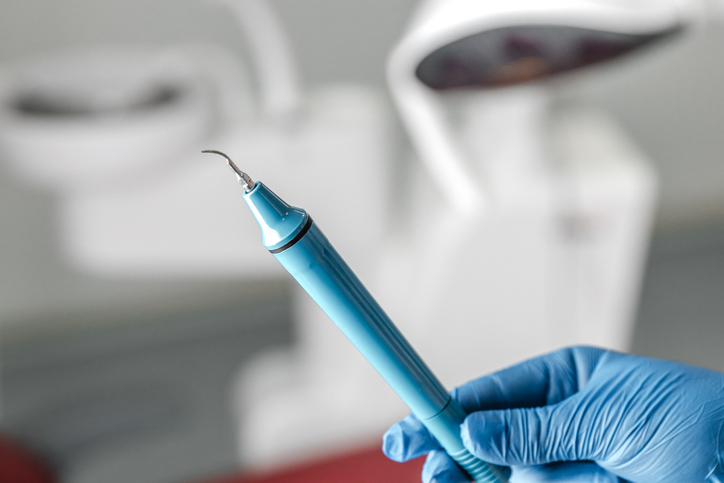
If a dentist has told you that you need gum surgery, that recommendation probably came with a description you did not enjoy hearing. Incisions. Stitches. A week or two of careful eating. Maybe a prescription you would rather not fill.
There is another way to get the same job done, and it has been available at our Babylon office longer than most patients realize. It is called perioscopy, and it replaces the scalpel with a camera small enough to slip beneath your gumline.
What is perioscopy?
Perioscopy is a nonsurgical gum disease treatment that uses a tiny fiber optic dental endoscope to look underneath the gum. The camera is threaded into the space between the tooth and the gum, and it sends a magnified live image of the tooth root to a monitor. That view lets a periodontist find and remove the plaque and hardened calculus causing the infection, without cutting the gum open or placing stitches.
The short version: perioscopy gives Dr. Scharf the visibility of gum surgery without the surgery.
Why a deep cleaning alone often does not solve the problem
Gum disease is driven by plaque and calculus, the hard crusty deposits that build up on the root surface below the gumline. Those deposits inflame the gum tissue and destroy the bone that holds your teeth in place.
For decades there were only two ways to deal with it. The first was scaling and root planing, commonly called a deep cleaning, where instruments are worked blindly below the gumline by feel. The second was gum flap surgery.
Deep cleaning has a real limitation, and it is not a matter of effort or skill. Once a periodontal pocket reaches 5mm deep, studies show roughly a 90% chance that the root will still be left contaminated afterward. That figure holds even with expert hygienists working with unlimited time. Nobody can reliably clean a surface they cannot see.
Healthy pockets measure about 2mm to 3mm. When your hygienist starts calling out numbers of 5 and higher, that is the threshold where blind cleaning starts running out of road, and it is usually the point where surgery gets mentioned.
How is perioscopy different from gum flap surgery?
Flap surgery solves the visibility problem by peeling the gum tissue away from the tooth so the root is exposed to direct view. It works. It also requires incisions, sutures, one to two weeks of healing, and sometimes an opioid prescription that many patients would prefer to avoid.
Perioscopy solves the same visibility problem from the inside. Instead of moving the gum out of the way, we send a camera in.
| Gum flap surgery | Perioscopy | |
|---|---|---|
| Access to the root | Gum tissue is cut and lifted | Camera slips under the gum, no incision |
| Sutures | Yes | No |
| Typical healing | One to two weeks | Minimal downtime |
| Pain management | May involve prescription pain medication | Typically over-the-counter |
| Tissue preserved | Some tissue loss is common | Gum tissue stays intact |
That last row matters more than patients expect. Gum tissue you keep is gum tissue you do not have to graft back later.
What happens during a perioscopy appointment?
Treatment is done under local anesthetic so the area is fully numb. The endoscope, an ultra-fine camera mounted on a flexible fiber stem, is guided into the periodontal pocket. Dr. Scharf watches the magnified image on a monitor and uses fine instruments to remove calculus and biofilm from the root surface, checking the image as he works to confirm the surface is actually clean before moving on.
Because the camera reaches around root curves and into furcations that instruments would otherwise miss by feel, the cleaning is verified rather than assumed.
The number of visits depends on how many teeth are involved and how deep the pockets have become. Your treatment plan is mapped out during your consultation, so you know the scope before anything begins.
LANAP plus perioscopy
Plenty of practices offer laser gum treatment. Dr. Scharf combines it with the endoscope, an approach the practice calls LANAP+Perioscopy.
The LANAP laser targets bacteria and diseased tissue inside the pocket without incisions or sutures. Perioscopy adds the visual confirmation, so the root is cleaned under direct view rather than blindly. Pairing the two is what separates this office from practices doing the laser alone, and it is the reason many second opinion patients end up staying.
Who is a good candidate for perioscopy?
Perioscopy tends to be a strong fit if you:
- Have been told you need gum surgery and want a second opinion first
- Have pockets that have not responded to repeated deep cleanings
- Have isolated problem areas rather than generalized advanced disease
- Have concerns about front teeth, where preserving gum tissue protects your appearance
- Want to avoid stitches, downtime, or prescription pain medication
- Have a medical history or a schedule that makes surgery complicated
It is not the right answer for every case. Advanced bone loss, badly compromised teeth, or certain anatomical situations may still call for a surgical approach or pocket reduction. An honest exam tells you which category you fall into, and we will tell you plainly if perioscopy is not your best option.
Why Long Island patients come to Babylon for this
Perioscopy is not widely offered. Very few periodontists in Suffolk County provide it, which is why patients travel from West Babylon, West Islip, and across Long Island to have it done here.
Dr. David Scharf was the first periodontist on Long Island trained and certified in perioscopy, and he has been the leader in providing it in the region for more than 20 years. The practice uses endoscopes from both Zest Dental and the DeVA-1 by OraVu. He is a Diplomate of the American Board of Periodontology, a Clinical Assistant Professor in the Department of Implant Dentistry at NYU, and was named Periodontist of the Year in 2024.
Patients who arrive expecting to schedule surgery are frequently surprised to learn they can keep their teeth and skip the scalpel entirely.
Frequently asked questions
Does perioscopy hurt?
The area is numbed with local anesthetic before treatment begins. Most patients describe the experience as comparable to a thorough deep cleaning rather than to surgery, and recovery generally does not require prescription pain medication.
How long does perioscopy take?
It depends on how many teeth are involved and how deep the pockets are. Your specific treatment plan, including the number of appointments, is reviewed with you at your consultation.
Is perioscopy covered by insurance?
Coverage varies by plan. Our treatment coordinator reviews your benefits and provides a written estimate before treatment starts, and we submit claims electronically at no additional charge.
Can perioscopy replace gum surgery completely?
In many cases, yes. Patients referred for flap surgery often turn out to be candidates for a nonsurgical approach instead. Advanced cases may still need surgical treatment, which is why an exam comes first.
What happens after treatment?
Gum tissue needs time to reattach and heal. Most patients move onto a periodontal maintenance schedule, usually every three months, so pockets can be monitored and bacteria kept from repopulating.
Find out whether you can avoid surgery
If someone has recommended gum surgery, get a second opinion before you schedule it. You may have options you have not been shown.
Learn more about perioscopy at our Long Island office, or call to arrange a consultation.